Last updated: 13 October 2026. Income from any online business varies widely and is never guaranteed. We removed unsourced claims from an earlier version and kept to what we can point to.
“Start an online business” is easy advice and hard work. There are many ways to do it, and they differ in how much money you need, how fast income arrives and how much skill you must already have. These seven models cover most of what Nigerians are doing online.
1. E-commerce stores
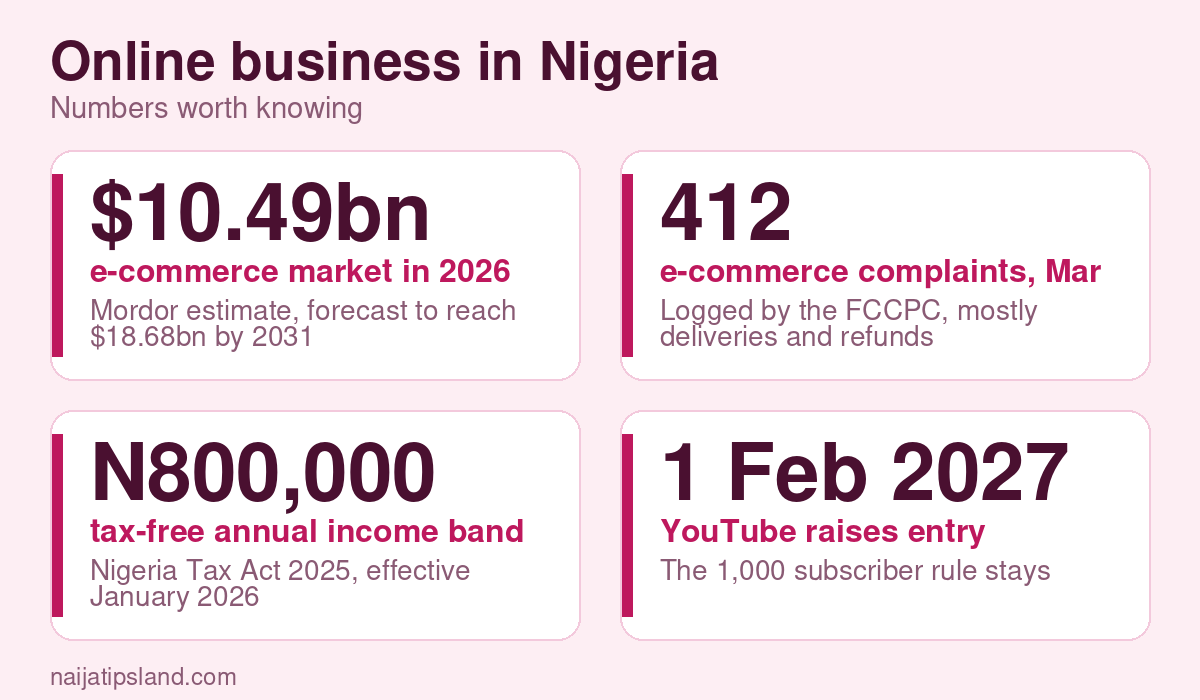
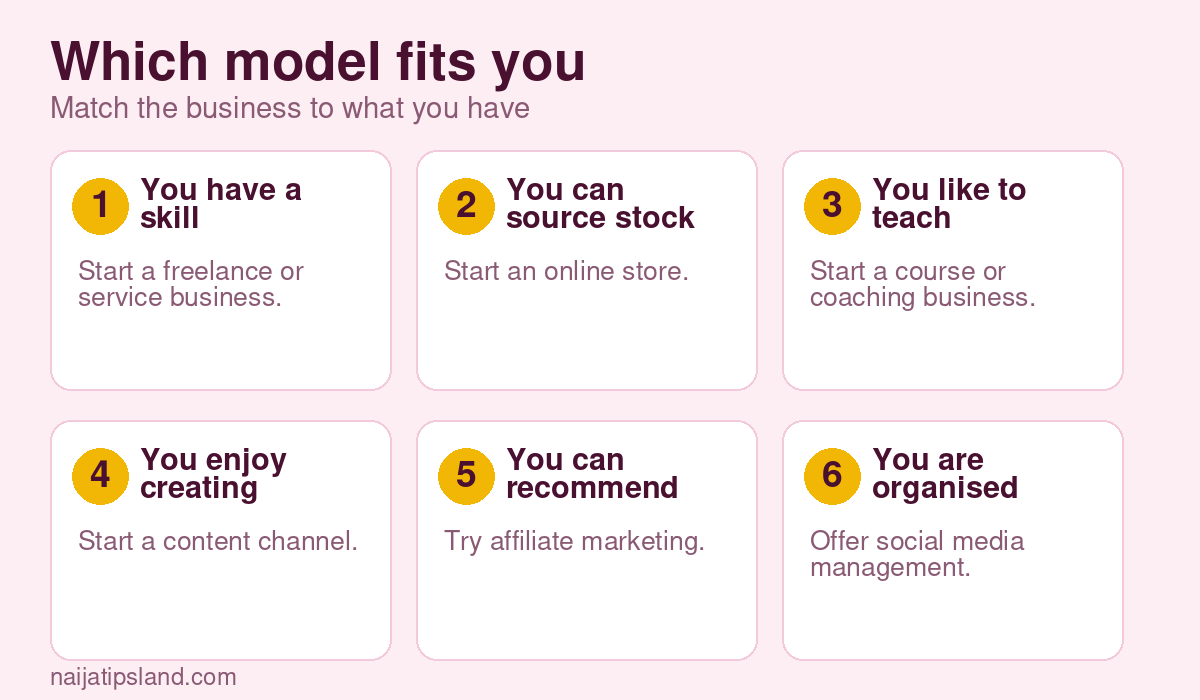
You sell physical products through a marketplace, social media or your own website. The market is large: Mordor Intelligence estimates Nigeria’s e-commerce market at about $10.49 billion in 2026, growing about 12% a year. But it is competitive, and delivery, refunds and fake goods cause friction: the FCCPC logged 412 e-commerce complaints in just six months of 2025. You need stock money, a delivery plan and a way to collect payment safely. Read where to sell online and the e-commerce market guide.
2. Freelance and service businesses
You sell a skill: writing, design, video editing, coding, bookkeeping, translation or virtual assistance. It needs little capital and can bring income within weeks, but it depends on finding clients and proving quality. Earnings are uneven, and survey data suggest fewer than one in ten Nigerian freelancers earn more than ₦350,000 a month. Many start by serving local small businesses before looking abroad. See our plan for earning online.
3. Content creation
Blogs, YouTube channels, podcasts and video pages can earn from ads, sponsors and your own products. Platform rules matter: YouTube is to double entry thresholds for new creators from 1 February 2027, with the 1,000-subscriber rule unchanged, and TikTok was reported not to offer direct creator payouts in Nigeria in August 2026. Meta made Nigeria eligible for monetisation in June 2024. Content takes months to build, so keep another income while you grow.
4. Affiliate marketing
You earn a commission when people buy through your recommendation link. It works when you have an audience that trusts you, such as a niche blog, a channel or a community, and it works badly when you spam links. Always disclose that you earn a commission, only promote things you have checked and be wary of programmes that pay mainly for recruiting others, which can be a pyramid scheme. Sponsored posts are also covered by advertising rules; see our guide to influencers and the rules.
5. Online courses and coaching
If you know something others want to learn, from a school subject to a trade skill, you can teach live or sell recorded lessons. Start by teaching a small group, learn what confuses people and then package it. Expect to spend time on materials, marketing and support. Be honest about results, and never promise jobs or income you cannot deliver.
6. Social media and digital marketing services
Small businesses often need someone to post, reply, make simple graphics and run ads. You can start with one or two clients, track results and grow into a small agency. Agree who pays for ad spend, set deliverables in writing and report monthly. See our guides on social media growth and digital advertising in Nigeria.
7. Digital products
Templates, ebooks, presets, spreadsheets, worksheets and software can be made once and sold many times. The upside is that your costs do not rise with each sale, and the downside is that you must still find buyers and keep the product good. Use a payment page that supports Nigerian payments, and protect your work.
The basics every online business needs
- Registration: register your business name, or a company if you will sign larger contracts. See business structures in Nigeria and how to register a business name.
- Payments: a business account and a payment provider you trust. See our fintech apps comparison.
- Tax and records: the first ₦800,000 of annual taxable income is taxed at 0%, but you still need to keep records and check your obligations. See our VAT guide.
- Safety: protect your logins, confirm payments in your own account and avoid anyone who asks you to pay to work. Read our guide on internet scams.
How to pick one
- List your skills, your money, your time and your contacts.
- Choose the model that uses what you already have.
- Test with one customer before you spend on tools or stock.
- Track money in and out weekly, and review after 90 days.
If you are starting with almost no money, read our list of online business ideas that need no capital.
Effort, Cost and Risk Compared
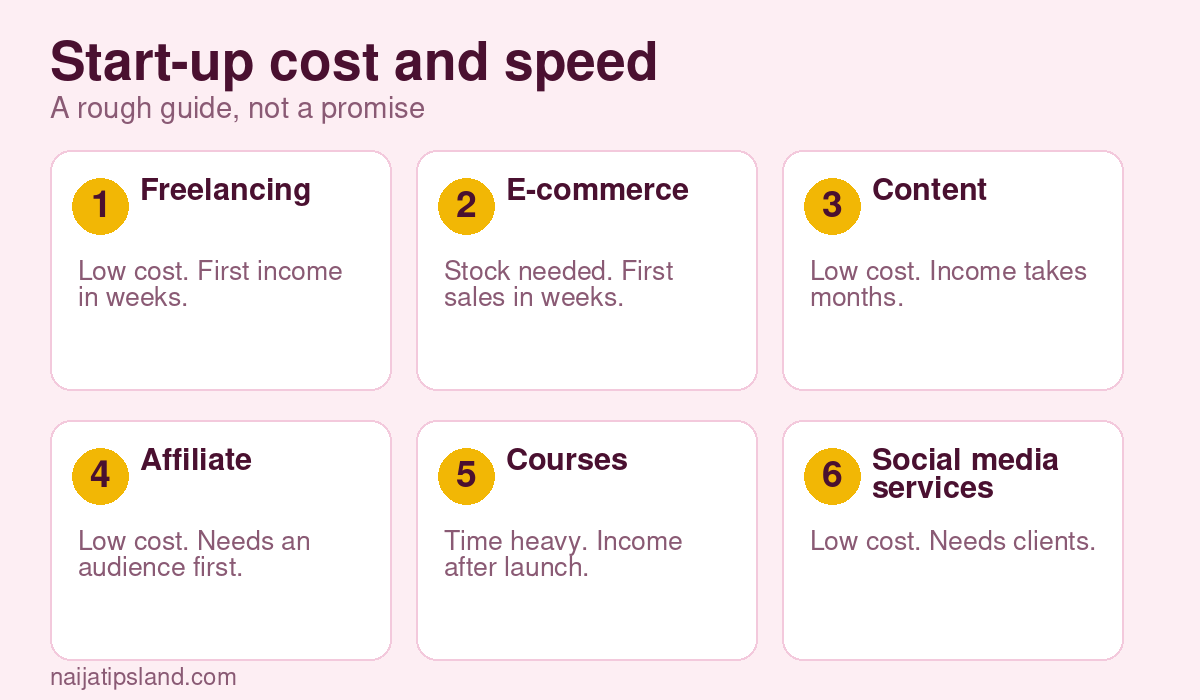
- E-commerce: medium effort, highest cash need because of stock, medium to high risk from unsold goods and delivery problems.
- Freelance services: high personal effort, low cash need, risk is mostly slow or unpaid clients.
- Content creation: steady effort over months, low cash need, risk is that income never materialises or platform rules change.
- Affiliate marketing: depends on an audience, low cash need, risk is losing trust through poor recommendations.
- Courses and coaching: heavy upfront effort, low to medium cost, risk of low sales and refunds.
- Social media services: moderate effort, low cost, risk of scope creep and late payment.
- Digital products: heavy upfront effort, low cost, risk that nobody buys.
Three Short Examples (Hypothetical)
- Ada, a graduate with design skills, starts as a freelancer with two local clients, builds samples from those jobs and later pitches an overseas client. Her income is uneven for the first months, so she keeps her part-time job.
- Tunde buys a small stock of phone accessories and sells through WhatsApp and a marketplace. He prices after counting delivery and payment fees and tracks which products sell.
- Ngozi, a teacher, runs weekend lessons online for a handful of students, then records the best lessons as a short course once she knows what they struggle with.
Mistakes That Sink Online Businesses
- Starting with a logo and a website before finding a single customer.
- Ignoring the cost of delivery, data and payment fees.
- Following influencers who sell courses rather than running businesses.
- Taking loans to fund an untested idea.
- Not registering or keeping records until a bank or client asks.
Legal and Ethical Basics
- Be honest in your advertising, and disclose paid promotions and commissions.
- Respect customers’ data under the Nigeria Data Protection Act 2023.
- Give fair refund and delivery terms, in line with consumer law.
- Do not sell what you do not own, including copied images and music.
Frequently Asked Questions
Which online business is best for beginners?
Service businesses, such as freelancing or social media management, have the lowest start-up cost, but they need a skill you can show.
Do I need to register an online business?
It is strongly advisable, and it helps with banking, payment providers and larger clients.
How long before I earn money?
Services can pay within weeks if you find clients, while content and courses take months.
Can I run an online business and keep my job?
Yes, and it is often wiser, but check your employment contract for conflicts.
Sources
- Nexdigm (citing Mordor Intelligence): Nigeria e-commerce market size
- The Guardian: FCCPC receives 9,091 complaints in 6 months
- MyJobMag: Remote work statistics 2026
- Brandspur: YouTube to double monetisation entry requirements from February 2027
- Brandcom: YouTube raises the bar for incoming creators
- Techpoint: Meta approves monetisation for content creators in Nigeria and Ghana
- Safeguard Global: Nigeria Tax Act 2025 goes into effect on 1 January 2026